How to Play Catcher's View
Other languages: 日本語 · 한국어 · Español · Português · 繁體中文
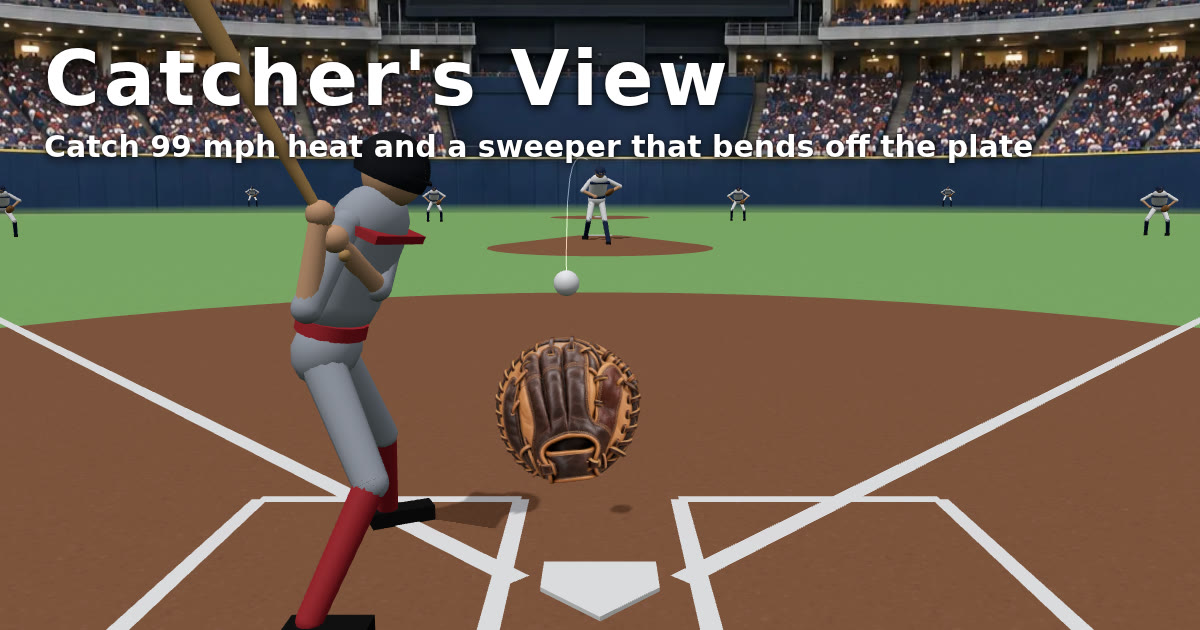 Play Catcher's View
Catcher's View is a 3D baseball game that puts you in the catcher's position to feel the speed and break of every pitch. Beyond the batter, the pitcher's ball flies toward your mitt. It's free and runs right in your browser.
How to play
- Press "Play Ball" on the title screen to begin.
- "Pitch" makes the pitcher throw one pitch. After you catch it, the speed, pitch type and call appear, and the umpire makes the call.
- Press "Bat" to choose where the next pitch will cross on a 5×5 grid before it's thrown. The batter swings at that square, and the result is a swinging strike, foul ball, grounder, fly ball, base hit or home run.
- The ball, strike and out counts advance, and your pitches, hits, home runs and strikeouts are shown.
Home Run Derby
See how many home runs you can hit in 20 pitches. The pitcher keeps throwing easy fastballs down the middle, and the batter only guesses dead center. You earn a title based on your home run rate, and you can share the result on social media.
Pitches come in at 78% of the chosen pitcher's fastball (Tornado Windup 72 mph, Two-Way Overhand 78 mph, Submarine 62 mph, Sidearm 69 mph). You earn "Legendary Slugger!" with 14 or more home runs out of 20, "Home Run King!" with 10 or more, and "Nice Hitting!" with 6 or more.
Pitchers and pitches by the numbers
There are four pitchers, all fictional and right-handed. The table lists each pitch's nominal release speed at every level; actual speeds vary slightly from pitch to pitch (standard deviation: 0.8% of the nominal value). "Share" is how often the pitcher picks that pitch when the pitch type is set to "Auto".
| Pitcher | Pitch | Share | Sandlot | High School | Pro | Major League |
|---|---|---|---|---|---|---|
| Tornado Windup | Four-Seam Fastball | 50% | 63 | 79 | 92 | 97 |
| Forkball | 40% | 55 | 70 | 81 | 85 | |
| Slider | 10% | 54 | 68 | 79 | 83 | |
| Two-Way Overhand | Four-Seam Fastball | 42% | 68 | 86 | 99 | 104 |
| Sweeper | 33% | 57 | 72 | 84 | 88 | |
| Splitter | 17% | 62 | 79 | 91 | 96 | |
| Cutter | 8% | 63 | 80 | 92 | 97 | |
| Submarine | Four-Seam Fastball | 40% | 54 | 68 | 80 | 84 |
| Sinker | 30% | 51 | 64 | 75 | 79 | |
| Curveball | 20% | 41 | 52 | 60 | 63 | |
| Changeup | 10% | 45 | 57 | 67 | 70 | |
| Sidearm | Four-Seam Fastball | 30% | 60 | 76 | 88 | 93 |
| Sinker | 30% | 56 | 71 | 83 | 87 | |
| Slider | 40% | 52 | 65 | 76 | 80 |
Levels compared
The level changes speed, spin, control, and how often the pitcher throws to the cell you guessed with "Bat" on. Speed and spin are multipliers relative to Pro. Control spread is the standard deviation of the miss from the aim point, both vertically and horizontally.
| Level | Speed | Spin | Control spread | Throws to your guess |
|---|---|---|---|---|
| Sandlot | ×0.68 | ×0.75 | 20 cm (7.9 in) | 30% |
| High School | ×0.86 | ×0.88 | 12 cm (4.7 in) | 25% |
| Pro | ×1.00 | ×1.00 | 7 cm (2.8 in) | 20% |
| Major League | ×1.05 | ×1.08 | 4.5 cm (1.8 in) | 15% |
At the Major League level, breaking balls move twice as much relative to the pitcher's fastball. The fastball itself, gravity and air drag are unchanged.
Settings
- Level: Sandlot, High School, Pro, Major League. Higher levels throw faster, break more and have sharper control.
- Pitch type: Auto, or one fixed pitch.
- Batter: Right-handed or Left-handed.
- Ballpark: Dome, Day Game, Night Game.
How the ball moves
Each path is calculated from gravity, air resistance and the Magnus force created by spin. Spin rate and direction differ by pitch type, so each pitch moves differently. A submariner lets the ball go near the ground, while an overhand pitcher releases it from high up.
The rubber is 18.44 m (60 ft 6 in) from home plate. The ball is modeled at 7.3 cm (2.9 in) across and 145 g (5.1 oz). The strike zone runs from 46 to 106 cm (18 to 42 in) above the ground, and a pitch is a strike if any part of the ball touches the zone.
FAQ
- Is it free? Do I need to sign up?
- It's free, with no sign-up or installation.
- What other languages are available?
- These versions are available: 日本語 · 한국어 · Español · Português · 繁體中文
- What is the fastest pitch?
- The Two-Way Overhand pitcher's Four-Seam Fastball at the Major League level, with a nominal speed of 104 mph.
- And the slowest?
- The Submarine pitcher's Curveball at the Sandlot level, at 41 mph.
- Which level is the "tops out around" speed on the pitcher card?
- It is always the Pro fastball, whatever level you choose. Actual speeds change with the level, as the table shows.
- How far does a ball have to go for a home run?
- The fence is 100 m (328 ft) down the lines and 122 m (400 ft) to center, and the ball has to clear its 4.2 m (14 ft) height.